
When the relationship looks stable, but does not feel it.
Renewal happened. The review meeting was civil. Nothing has visibly gone wrong. But you do not yet have the full picture. Some client relationships are thinning quietly. Others are stronger than the managed conversation suggests, and ready to grow. Without honest listening, you cannot tell which is which.

Arrive with data.
Leave with respect.
Because evidence should strengthen decisions and the relationships that depend on them.
The question most organisations avoid asking
Which client relationships are quietly at risk, and which are ready to grow?
Most organisations ask too late, too politely, or in the wrong setting entirely. They wait for an annual review, a post-project survey, or a senior courtesy call, then mistake managed feedback for honest feedback. Managed feedback feels reassuring right up until the renewal does not happen.
The problem is not indifference. It is design. Most client listening systems are built around conversations clients already know how to perform in. They stay constructive. They stay reasonable. They do not expose the fault line. And they do not surface the depth of trust that, in the right relationships, is already there and waiting to be acted on.
What we do
We run structured listening programmes that get beneath what clients say in managed conversations.
We ask the questions that do not belong in an account review, in ways that make candour feel safe rather than risky. We pay close attention to what clients write, not only what they score, because a number tells you what they think, but the language tells you why. And the why is where the relationship either holds or starts to give, and where genuine advocacy, when it exists, becomes visible.
We do not hand you a dashboard and leave. We bring judgement: what we heard, what it means, where the relationship is strong, where it is thinning, and what it is now asking of you.
What changes
When clients know they have been genuinely heard, the relationship changes shape.
Problems surface earlier. Expectations get clearer. Account teams stop guessing and start dealing with what is true. Relationships that have been properly heard tend to recover faster, hold more calmly, and create more room for growth.
The programme also surfaces something most organisations never go looking for properly: the clients whose confidence runs deeper than any managed conversation revealed. The ones who would refer you, introduce you, speak well of you in rooms you are not in, and expand the relationship if someone thought to ask. That signal is as commercially valuable as the early warning.
And when the experience is handled well, clients do not just respond. They respond warmly. One described it as ‘valuable beyond expectation, and pleasurable beyond reason.’ That is not the language of a completed survey. It is the language of a relationship that has been properly heard, and is ready to go further.
Proof
Hotwire Global. Six consecutive years of structured client satisfaction programmes. Response rates rose year on year. Country offices exceeded 85% participation. The programme generated 249 active referrals. Those referrals did not come from a separate growth initiative. They came from the same programme that was protecting existing relationships.
“Getting structured feedback through a trusted independent third party like Q&R plays an incredibly important role in the way we manage our client agency relationships. Every year we do it, we not only celebrate great results but we actually open new opportunities and in rare instances, save relationships. It’s appreciated by our clients and forms the basis for our forward account planning across the agency.”
Aurora Healthcare Communications. 94% of client companies responded. 19 new business leads were generated within twelve months. Overall satisfaction reached 91% following the second programme. The same listening programme that showed where relationships needed attention also showed where client confidence was strong enough to convert into growth.
“Having an external partner with expertise for measuring client satisfaction has given us the highest response rate ever and provided the rigour and discipline to help us find out what our clients think and feel. The data is of excellent quality enabling our senior team to grow and retain our clients.”
The Book
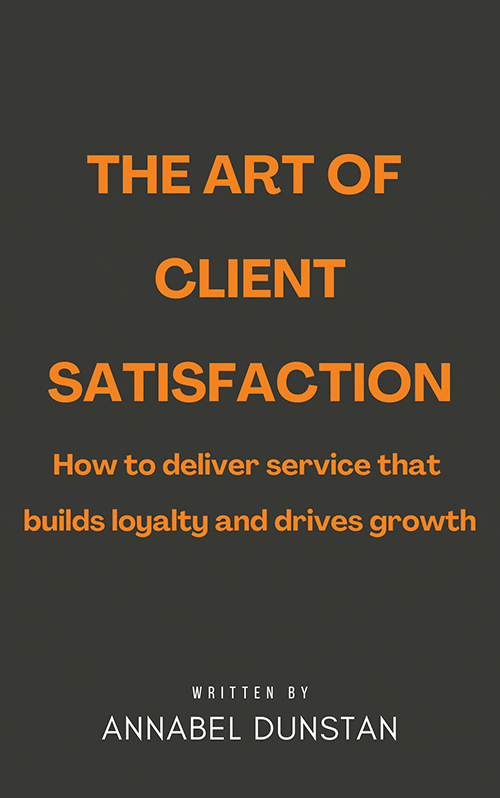
Most books about client satisfaction are really books about client service. The Art of Client Satisfaction is not that book.
Annabel Dunstan’s argument is that satisfaction is not a service standard. It is a relationship condition. Competent delivery is not enough if the underlying dynamic is weak. The book explains why polite clients are not always secure clients, why strong relationships are not always visible advocates, and why the quality of the question matters as much as the answer.
If a client relationship has started to feel different, or if you suspect some relationships are stronger than the data currently shows, now is the right time to find out.