
When renewal is holding, but belief may not be.
Attendance is acceptable. No public complaints. No dramatic exits. But you do not yet have the full picture. Some members are renewing on inertia. Others are more committed than any survey has revealed, ready to advocate, refer, and bring others in, if someone asked them the right question.

Arrive with data.
Leave with respect.
Because evidence should strengthen decisions and the relationships that depend on them.
The question most organisations avoid asking
Who is renewing on inertia, and who is ready to advocate?
Retention is not the same as loyalty. An organisation can sustain decent renewal rates on inertia while the underlying relationship quietly erodes.
The difficulty is that members are usually polite. They renew. They attend. They answer surveys in broadly positive terms.
What they do not always do is tell you what they actually think, because criticising the organisation you belong to can feel uncomfortably close to criticising the community it represents.
And the members who feel strongly in the other direction, the ones who would speak for you, bring others in, or champion the organisation more publicly, often stay quiet too.
The survey does not find them. Honest listening does.
What we do
We design structured listening programmes that give members a safe, credible channel for honesty.
We ask what they actually value, what they would genuinely miss, what they would change, and what the membership has not yet offered them. We look closely at the language members use when they are not being asked to score anything, because that is where loyalty, and its opposite, are most clearly visible.
We pay attention to the difference between what long-standing members feel and what newer members feel. That gap often reveals where the organisation has changed, or failed to. It also reveals where the strongest advocates are concentrated, and what has sustained their commitment over time. Then we return a clear picture of where the relationship is strong, where it is fragile, and what action is most likely to move it.
What changes
When members trust that their voice shapes how the organisation operates, participation deepens.
An invested member behaves very differently from a merely retained one. They refer. They advocate in rooms you are not in. They tell you when something is wrong instead of quietly drifting. Leadership can then speak more credibly about what members value, what is frustrating them, and what has been done about it.
The programme also surfaces something organisations rarely go looking for deliberately: the members who are already acting like ambassadors. The ones whose commitment is obvious the moment someone asks the right question, who would speak at an event, contribute to a publication, mentor a newer member, or bring a colleague into the fold if anyone thought to ask. Identifying those people and giving their commitment somewhere useful to go is not a separate initiative. It is what structured listening makes possible.
Retention stops being the lagging indicator everyone stares at. It becomes the consequence of a relationship that has been taken seriously, and the platform from which growth becomes possible.
Proof
Federation of Master Builders. A multi-year relationship that reshaped how the FMB onboards members, closes the feedback loop, and builds genuine connection across a national membership base.
“Having worked with Question & Retain over many years, I’ve seen firsthand the impact that intentional listening and insight-led action can have. My own organisation, the FMB, has evolved how we onboard members, how we close the feedback loop, and how we build genuine connection, and much of that was sparked by what we learned through Q&R’s process.”
Supporting proof: Airport Operators Association. Overall membership satisfaction increased by 33 percentage points over two years, from 41% of members describing themselves as genuinely satisfied to 64%. The shift was tracked consistently year on year, giving leadership a clear read on what was working and what members felt had been acted on.
The Book
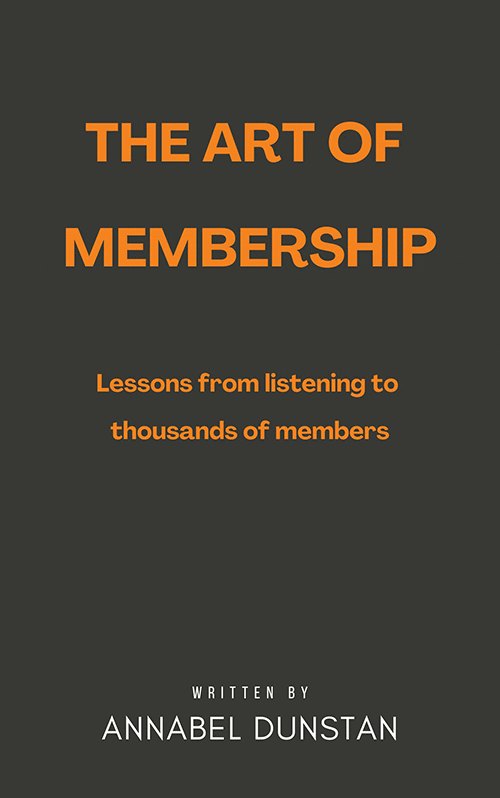
The Art of Membership begins with a provocation many membership organisations would rather avoid: the hardest thing about loyalty is not knowing what members want. It is accepting that they may want something different from what you have decided to offer, and being willing to find out.
That is why the book belongs here. It is a working guide to relevance, belonging, responsiveness, and the discipline of proving to members that what they said made a difference. It gives equal weight to protecting the relationships at risk and celebrating, loudly and deliberately, the ones that are working.
If renewal is holding but you want to know who believes and who does not, and who is ready to become your loudest advocate, we know the questions to ask.