When the picture others hold of you is not the one you think you are presenting.
The press coverage is fine. Key relationships are cordial. Nothing is visibly wrong. But you do not yet have the full picture. Some stakeholders are forming a view that would concern you if you knew about it. Others hold a level of trust in you that you are not yet making full use of. Structured perception work finds both.

Arrive with data.
Leave with respect.
Because evidence should strengthen decisions and the relationships that depend on them.
The question most organisations avoid asking
Where is confidence thinning, and where is trust stronger than you think?
Reputation is the gap between what you intend and what others experience. Most organisations rely on impression, proximity, and the absence of bad news. None of that is the same as information.
The absence of bad news is the absence of information.
The problem with direct conversations is simple: stakeholders are rarely incentivised to be candid in managed settings. They are incentivised to be cordial. Which means the honest signal often does not surface in the room where you are most likely to look for it. That applies equally to the concerns building quietly and to the genuine support sitting there unused.
What we do
We design structured perception studies that show how stakeholders actually see you, not how they perform for you in direct conversation.
We build each study around the relationships and decisions that matter most: which audiences, which assumptions, which aspects of your reputation, and which choices are being made on instinct rather than evidence. We ask the questions that do not belong in a bilateral conversation, then help you work out what the answers mean and what to do with them, whether that means managing a risk, correcting a misconception, or making better use of trust that is already there.
The result is a clear account of where you stand, where the risk sits, and where the trust is strong enough to build on.
What changes
When you know how stakeholders actually perceive you, decisions that were previously based on instinct become grounded in evidence.
Communications become better aimed. Relationship investment goes where it is most likely to move something. Decisions about positioning, partnership, policy, and behaviour become clearer because they are being made against a truer picture of how you are being read.
The same perception study also surfaces the stakeholders whose trust runs deeper than any managed conversation suggested: the commissioners, partners, or community voices who would speak for you, endorse you, or back you in a difficult moment, if they knew you wanted them to and someone thought to ask. Q&R does not just tell you where trust is breaking down. It tells you where trust is strong enough to build on.
The less visible gain is early warning. Problems are easier to correct while they are still small, specific, and private.
Proof
Suzuki GB. Three structured feedback programmes over twelve months. More than 6,000 car buyers and prospects surveyed. The findings did not only protect existing relationships. They produced £150,000 in identified value from a programme that cost £7,800 to run, a conservative return of 19:1, by surfacing what customers actually wanted and enabling Suzuki to redesign communications and launch new initiatives accordingly.
Clair Phillips, Manager CRM at Suzuki GB, described working with Q&R as invaluable in deepening the company’s connection with its customers, giving the business real-time responses to its communications and a clearer understanding of what customers actually required.
“We have been able to make significant savings across some of our communications as well as implement new initiatives to reward our customers and support new strategies, all based on what we learned.”
LNER. The value is not the data alone. It is the counsel on what to ask, and the judgement applied to what comes back.
“The team at Q&R, with their background in internal comms and measuring the employee experience, is well placed to help me get real time data I need. They offer a slick professional service with smart advice and counsel on what questions to ask and valuable insight on what the data is saying. They are also very approachable and a delight to work with.”
The Book
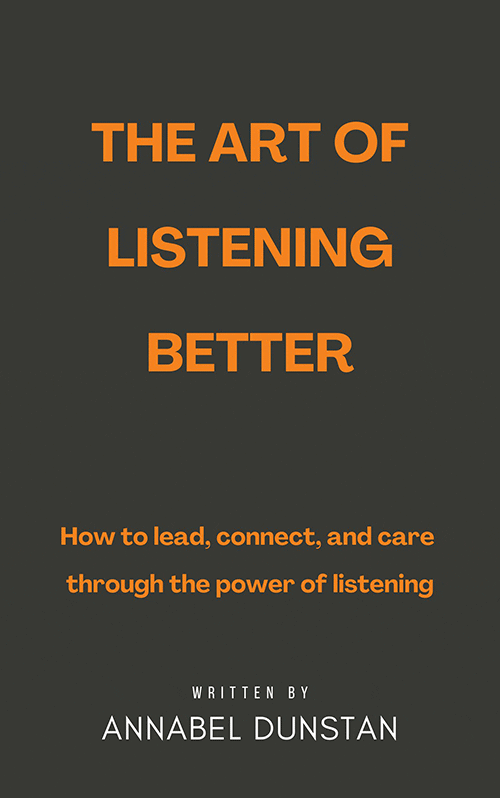
The Art of Listening Better is about what stops organisations and the people leading them from hearing what is actually being said, as distinct from what they expected or hoped to hear.
That is why it belongs here. Stakeholder perception is rarely distorted by a lack of data alone. More often, it is distorted by overconfidence in direct relationships, selective listening, and the assumption that if nobody has said anything bluntly, nothing serious is going on. The book deals with exactly those habits, and with the judgement required to hear difficult signals early and make better use of trust when it is already there.
If you suspect the picture others hold of you is not the one you are presenting, or if you think there is goodwill out there you are not yet making use of, we can find out.