When the survey looks fine, but the mood does not.
Scores are within range. Nothing looks dramatic. But you do not yet have the full picture. Some of your people are telling you what is safe rather than what is true. Others are having an experience of this organisation that, if you understood it properly, would change how you lead, recruit, and develop. Honest listening surfaces both.

Arrive with data.
Leave with respect.
Because evidence should strengthen decisions and the relationships that depend on them.
The question most organisations avoid asking
What is it actually like to work here, and where is the culture already stronger than the headline score suggests?
Most employee listening programmes are designed to produce reassuring data. The questions are softened. The anonymity is promised but not always felt. The results are presented and filed. What they rarely produce is an honest account of what it is actually like to work here, in either direction: the pressures building quietly beneath a stable score, and the genuine strengths nobody has thought to identify and amplify.
People are not dishonest in these surveys. They are rational. They calculate what is safe to say and they say that. If the culture does not feel psychologically safe, the data will not surface what is psychologically unsafe. And the people who genuinely love working here often learn that saying so is not the same as being heard.
What we do
We build listening programmes that give people a genuine reason to be honest.
We write questions that open rather than close. We make anonymity real rather than performative. We collect qualitative responses alongside quantitative scores because the language people use often tells you what the headline number cannot: where the pressure sits, what keeps recurring, what one part of the business is living with that another is not, and where the culture is working as intended.
We analyse the data ourselves and return with a clear account of what we found, what it asks of leadership, and how to show people that what they said led somewhere they can see.
What changes
When employees trust that feedback leads somewhere, the conversation inside the organisation changes.
People stop managing upwards quite so carefully. Managers stop defending and start responding. Leadership stops being surprised by problems that should have surfaced months earlier.
The same programme also finds the people already making the culture work: the teams, managers, and employee voices whose experience of the organisation is genuinely strong. The ones who would recommend this place without being asked, whose stories are more credible than any employer-brand campaign, and whose experience can teach the rest of the organisation something worth repeating.
The result is not simply a better score. It is a workplace where trust is more visible, communication is more credible, problems arrive early enough to solve, and the people already making the culture work are seen clearly enough to be built on.
Proof
Cavendish Consulting. eNPS increased by 29 points following a structured listening programme. Analysis by business unit and seniority gave leadership a precise picture of where the experience was strong, and where it was not.
“Working with Q&R has been an entirely positive experience. Providing an anonymous and unattributable place for our people to tell us what they really think, they’ve taken away the heavy lifting involved in an internal survey, giving our central team the space to drive tangible action in response to the feedback.”
Elsevier International Publishing. A regular feedback cycle across a large employee base, delivering timely, granular data that changed the quality of senior conversations and gave leadership the material to have more insightful discussions about what was working and what was not.
“Q&R gets the balance right: there’s plenty of hand holding but also freedom to flex if the business asks us to. I love the fact we have a regular feedback cycle with the employees, and the data is gold dust. We’re able to see what’s working and what isn’t and plan appropriately. And because I always have timely and relevant feedback to hand, I can have more insightful discussions with senior leaders.”
The Book
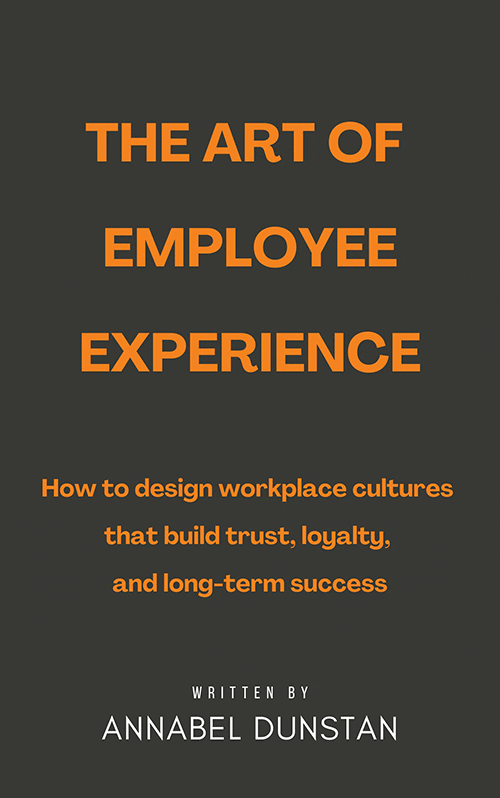
There is a version of employee experience thinking that treats people as an internal customer segment to be managed. The Art of Employee Experience rejects that framing.
Annabel Dunstan’s point is simple: how it feels to work somewhere shapes how it feels to be served by it. The book helps leaders think more clearly about trust, follow-through, and the lived quality of work, rather than settling for neat metrics and an overconfident summary. It is as useful for understanding what is working, and how to build more of it, as it is for understanding what is not.
If your data says fine but the room says something different, or if you suspect your best people stories are going untold, we should talk.